















Modern batteries are becoming more powerful, but the technology managing them is advancing just as quickly.
Behind an EV battery, backup-power system, or large energy-storage installation is a Battery Management System (BMS) working continuously to keep the battery within safe operating conditions.
Early BMS designs focused mainly on protection. Modern systems go much further. They combine precision sensing, embedded electronics, software, communication, and increasingly intelligent algorithms to understand not only what a battery is doing now, but also how its condition is changing over time.
This shift is turning the BMS from a basic protection circuit into the intelligence behind modern battery systems.
What Makes a Modern BMS “Advanced”?
At its core, a BMS monitors a battery and controls how it charges and discharges. It measures conditions such as voltage, current, and temperature while protecting cells from operating outside safe limits.
Advanced systems add another layer: they use the collected information to estimate battery condition and make better operating decisions.
- Monitoring individual cell voltages and temperatures
- Estimating State of Charge (SOC) and State of Health (SOH)
- Controlling charging and discharge limits
- Managing cell balancing
- Detecting abnormal battery behavior
- Communicating with chargers and other controllers
- Recording battery operating and diagnostic data
In an electric vehicle, these functions become especially important because hundreds or thousands of cells must operate together as one high-voltage battery.
For a more detailed explanation of the fundamentals, see our guide on why the Battery Management System is so important in an electric vehicle.
From Battery Protection to Battery Prediction
Traditional battery protection is largely reactive. If voltage becomes too high, temperature exceeds a limit, or current becomes excessive, the BMS takes action.
Advanced battery management is increasingly becoming predictive.
For example, one cell group might slowly begin behaving differently from neighboring cells. Its voltage may fall slightly faster under load, or its temperature response may gradually change.
The difference might not initially be large enough to trigger a fault. However, analyzing that behavior over many charging and discharging cycles could reveal a developing battery problem.
This is where accurate State of Charge (SOC) and State of Health (SOH) calculations become particularly valuable.
SOC estimates how much usable energy remains in the battery, while SOH provides an indication of how the battery’s current condition compares with when it was new.
These values are difficult to calculate accurately because battery behavior changes with temperature, electrical load, chemistry, age, and operating history.
The better the BMS understands these changes, the better it can estimate remaining energy and detect deterioration.
Why Cell-Level Monitoring Still Matters
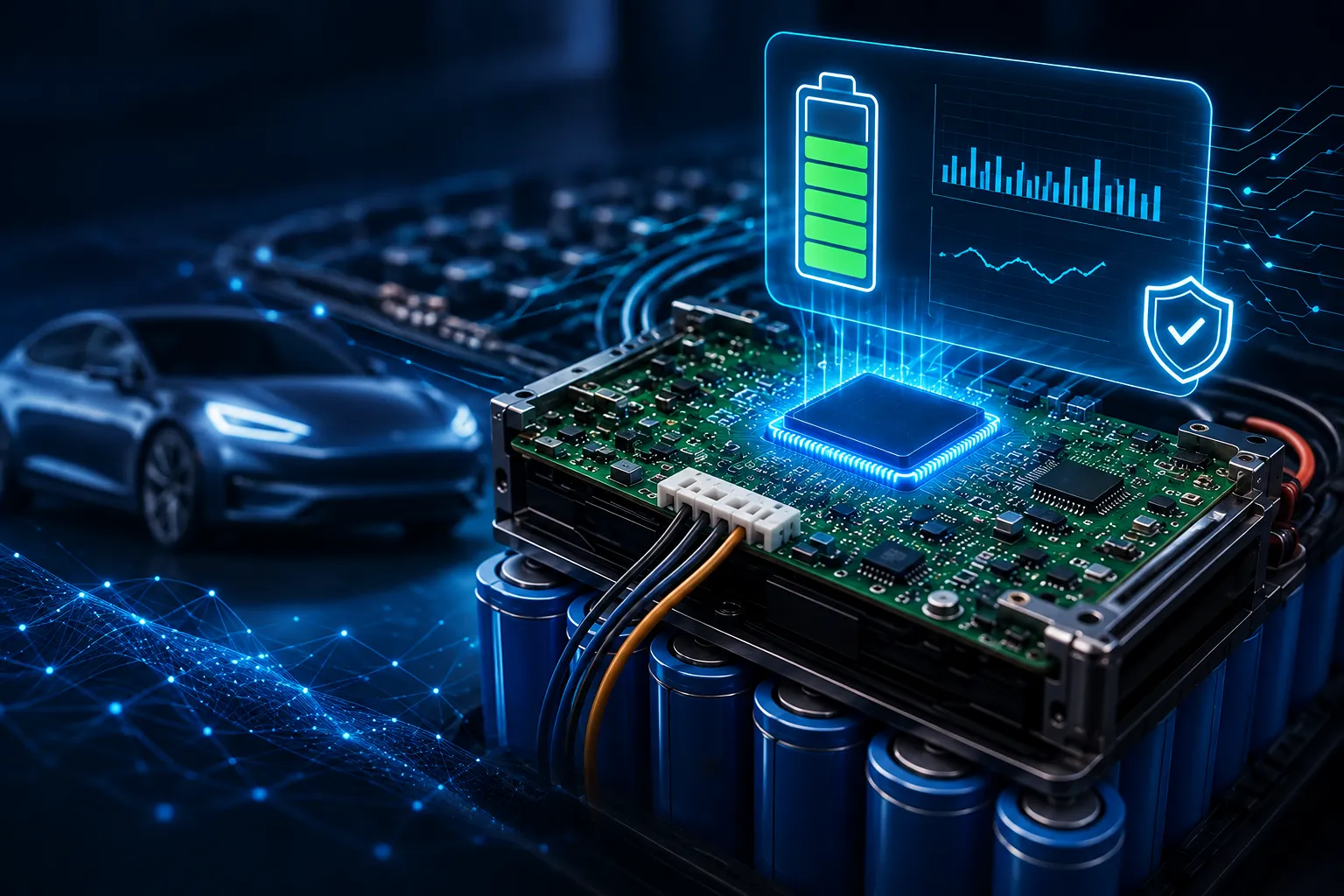
Even the most advanced software depends on accurate information.
A battery pack may appear healthy when looking only at total pack voltage, while one individual cell or group is approaching its operating limit.
That is why modern BMS platforms rely heavily on precise voltage, current, and temperature measurements.
Cell balancing is also important because battery cells do not age identically. Small differences in capacity and voltage can develop over time, eventually allowing a weaker cell to limit the usable capacity of the entire battery pack.
For a deeper explanation, see why cell balancing is critical in an EV battery pack.
How AI Is Entering Battery Management
Artificial intelligence and machine learning are opening new possibilities for battery diagnostics.
Traditional BMS software relies heavily on engineering models, calibrated limits, mathematical calculations, and predefined rules. Those methods remain essential, particularly for safety-critical functions.
Machine learning can complement them by finding patterns within large amounts of battery data.
AI-based approaches are being explored for applications such as:
- Battery degradation prediction
- More accurate SOC and SOH estimation
- Thermal anomaly detection
- Charging optimization
- Early fault detection
- Remaining useful life estimation
- Predictive maintenance
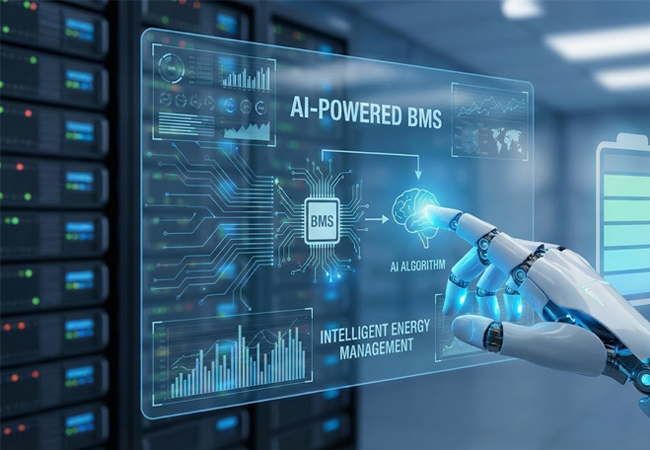
The purpose isn’t simply to make a battery “AI-powered.”
The real advantage is the possibility of recognizing subtle changes before they develop into serious problems.
A battery cell could technically remain within its acceptable limits while gradually showing unusual voltage, resistance, or temperature behavior. An intelligent diagnostic system may eventually be able to recognize these trends earlier than conventional threshold-based monitoring.
Battery degradation is also affected by temperature, charging habits, storage conditions, discharge depth, and other factors. We cover these in more detail in our article on the hidden causes of EV battery degradation.
Why Advanced BMS Technology Matters for EVs
Electric vehicles place particularly high demands on their batteries.
An EV battery must handle acceleration, regenerative braking, temperature changes, repeated charging, high electrical loads, and DC fast charging.
The BMS constantly evaluates these conditions to determine how much power the battery can safely deliver or receive.
It also communicates with other important vehicle systems, including the inverter, onboard charger, thermal-management system, DC/DC converter, and vehicle controller.
These components are all part of the vehicle’s larger electrical system. Our guide to EV high-voltage architecture explains how they work together.
The BMS Has a Major Role in Fast Charging
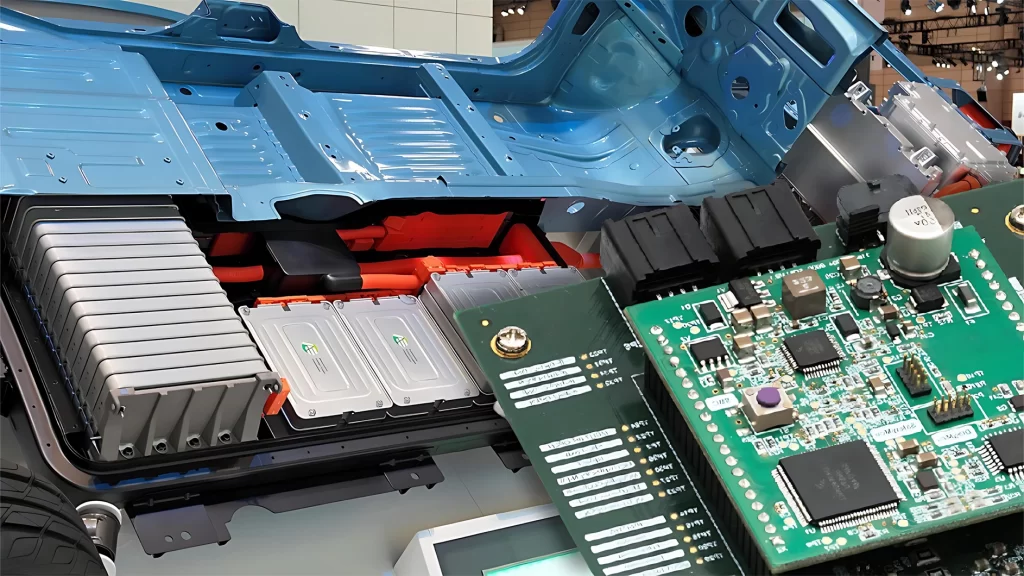
A fast charger does not simply push its maximum advertised power into an EV battery.
The vehicle and battery determine how much power can safely be accepted.
The allowable charging rate can change according to battery temperature, State of Charge, cell voltage, battery chemistry, health, and thermal limits.
This explains why an EV capable of very high peak charging power may only achieve that rate under certain conditions.
During charging, the BMS continually evaluates battery conditions and adjusts allowable power. The challenge is finding the best balance between charging speed, battery safety, temperature, and long-term degradation.
Battery chemistry also affects these decisions. LFP, nickel-rich lithium-ion, NiMH, and emerging battery technologies do not behave identically.
Our guide to the different types of batteries used in electric vehicles explains these differences in more detail.
BMS Technology Goes Beyond Electric Vehicles
The same technology is important anywhere rechargeable batteries need to operate reliably.
In UPS and backup-power systems, a BMS monitors battery condition so stored energy is available when the electrical grid fails.
In renewable-energy storage, battery management works alongside larger Energy Management Systems to control charging, discharging, temperature, and available energy.
Phones, laptops, power tools, drones, and other rechargeable electronics also use battery-management technology on a smaller scale.
The applications may be different, but the objective is similar: operate the battery safely while getting useful performance and lifespan from it.
Wireless BMS, Cybersecurity, and What's Coming Next
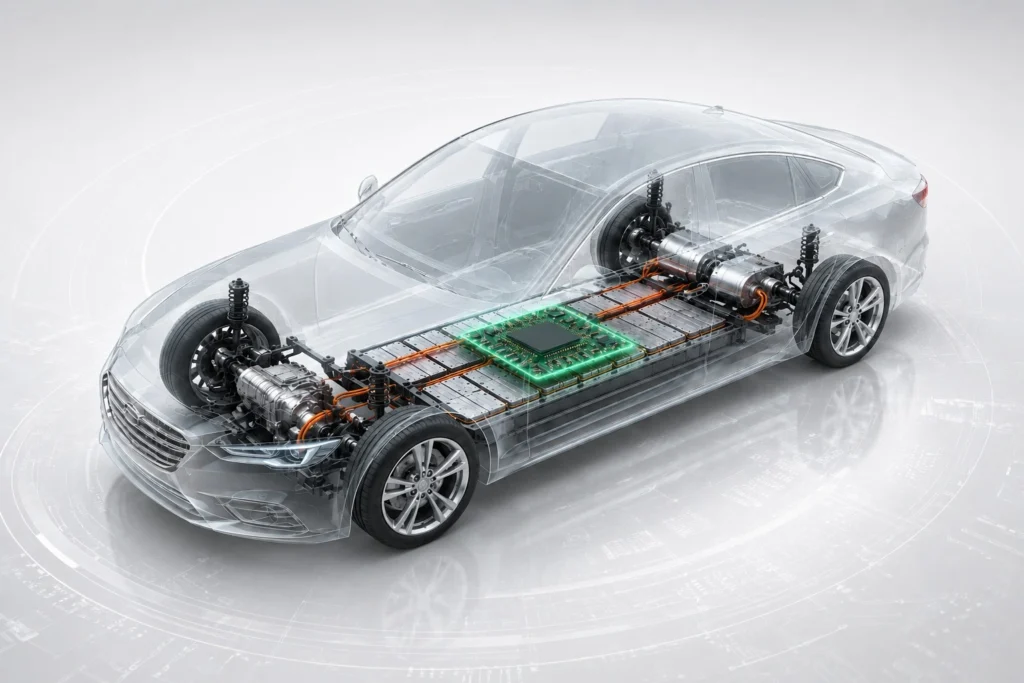
Another important development is the wireless BMS.
Traditional EV battery packs use communication wiring between modules and monitoring electronics. Wireless architectures can potentially reduce some of that wiring, which may simplify assembly, reduce weight, and provide more flexibility in battery-pack design.
Greater connectivity also creates new cybersecurity requirements.
As BMS platforms communicate with vehicles, chargers, diagnostic tools, cloud services, and manufacturer systems, protections such as secure firmware, authentication, secure boot, and protected software updates become increasingly important.
Other developments likely to shape future BMS technology include:
- Predictive battery diagnostics
- Edge AI and cloud battery analytics
- Smarter fast-charging strategies
- Second-life EV battery management
- Improved cybersecurity
- Support for solid-state and emerging battery chemistries
- More accurate battery-life prediction
The BMS of the future will therefore do much more than ask, “Is the battery operating safely?”
It will increasingly attempt to determine how the battery is changing, what problems may be developing, and how it should be operated to achieve the best balance of safety, performance, and lifespan.
Final Thoughts
Battery Management Systems have evolved far beyond simple protection circuits.
Modern BMS technology combines sensing, embedded hardware, software, diagnostics, communication, and increasingly intelligent algorithms to better understand battery behavior.
For electric vehicles, this can contribute to safer operation, more accurate range estimates, better charging performance, earlier fault detection, and longer usable battery life.
The same evolution is happening in UPS systems, renewable-energy storage, chargers, and other battery-powered equipment.
As batteries continue to improve, the intelligence managing them may become just as important as the battery cells themselves.